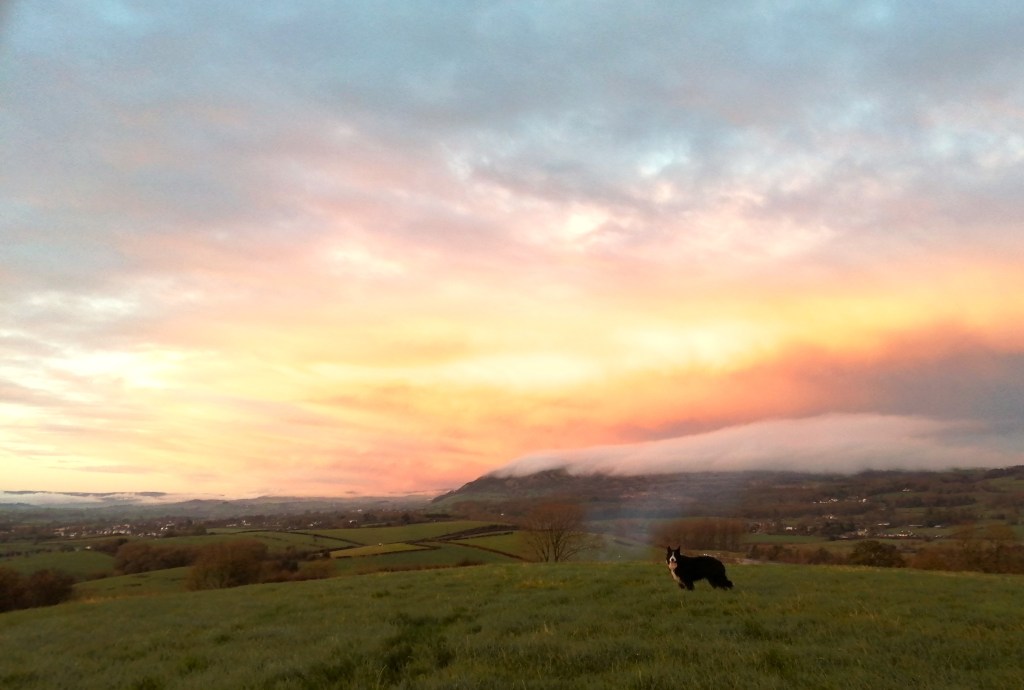
Bonfire night, and a sunset in a north-easterly sky.
Rare autumnal sun this year, plunging into Morecambe Bay behind me and Jessie on Hanging Hill enflamed the arse-end of a front that had plagued us all day. She bothered a scratty stick while I gathered a few rain-fattened waxcaps; then the mysteries of temperature differentials conjured a shroud of fog on Farleton Knott that soon cascaded into surrounding valleys and muzzled most folk’s fireworks.
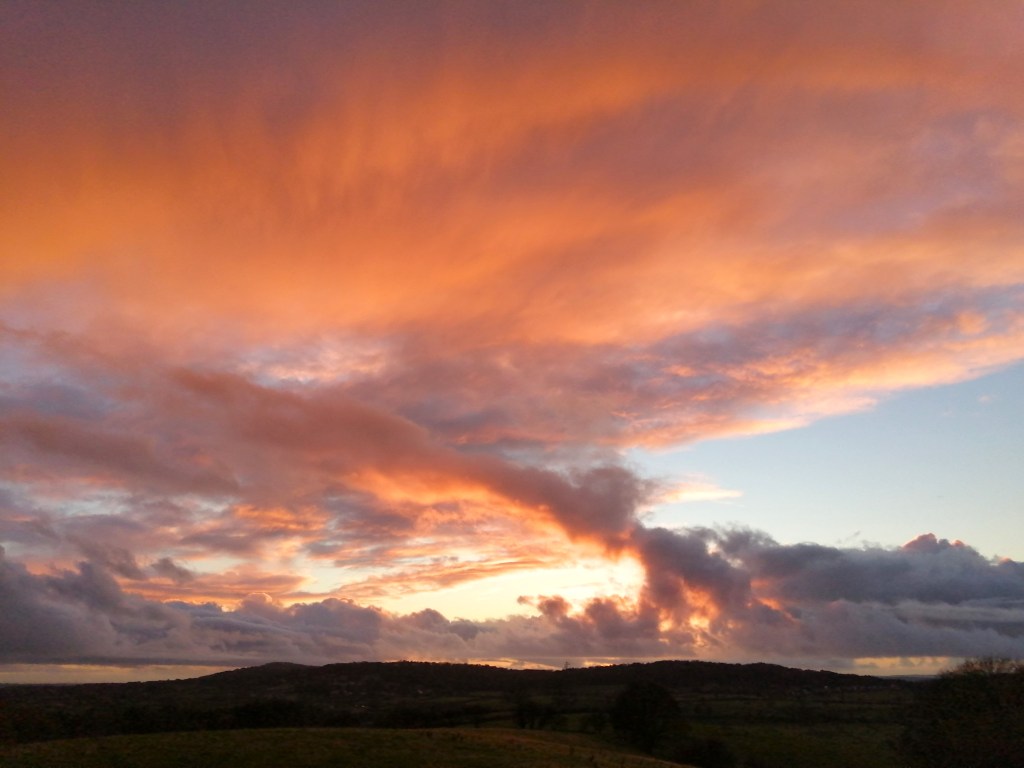
Nature’s own pyrotechnics over Yealand and Arnside Knott…..more mind-bending than any air-bomb repeater.
Just visible in the first picture, west of Farleton’s stubby snout, is a burgeoning metropolis, a hodgepodge of buildings that have recently sprouted in the fields around Junction 36 of the M6 motorway. That ignoble interchange is more or less the reason for this blog; the catalyst for whatever crimes against the English language are committed under its banner.
It was deemed necessary to have some sort of internet-based presence and as I’m not pithy, swarthy or agile enough for TikFaceTwitTok, this is where you may stumble across my random spoutings inspired by the increasingly stuttering rambles that Jessie and I undertake in the often overlooked environs of Junction 36.
Today’s concerns the M6 itself, whose monstrous carriageways blight the views of many a good walk in the area. Adding insult to injury, the unimaginable quantities of concrete required to create its snaking girth gouged vast cataracts in the local limestone landscape. A fair swedge of nearby Warton Crag, where evidence of pre-Stonehenge neolithic activity has been unearthed, was blasted from existence in its cause.
The wind is from the south-west as I write so the thundering reverberations of the 18-wheel juggernauts are clearly audible from a mile away. This goes on all day and all night and has done, with an all too brief covid reprieve, since the seventies. Fairly often, in summer, from Farleton Knott’s lunar summit, all 10 visible miles of the road, all 6 lanes, are nose-to-tail gridlocked.
Thousands upon thousands of rubber-tyred, alloy-wheeled, metallic-painted, air-conditioned, leather-upholstered metal boxes. Each one comprised of thousands upon thousands of intricately manufactured components made of steel and plastic and aluminium. And copper and silver and platinum and gold. And poisons like bromine and chlorine, mercury and lead. Imagine the energy used to make it all. And all of it using tons of energy going nowhere. One stretch of road in one piddling area of one piddling country.
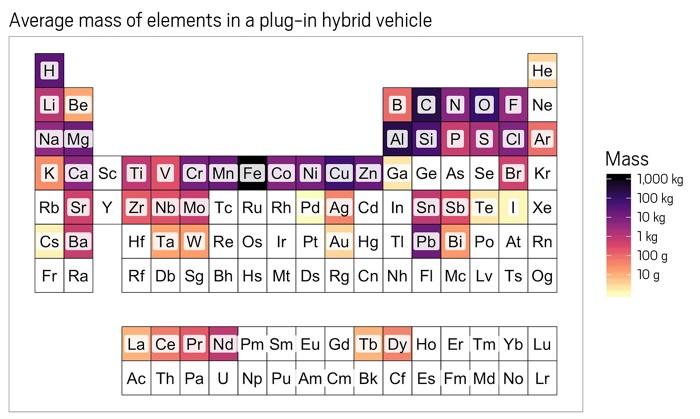
Internet find, ‘Chemical & Engineering News.’ Possibly reliable.
Back in physics lessons in the 80’s, old man McManus chortled malevolently, “You’ll have no need of cars you lot. Oil will have run out in 30 years.” A 2008 US Geological Survey of Arctic land basins estimates to have found 90 billion recoverable barrels. Offshore, where the largest deposits are believed to lurk, has yet to be studied.
Are ‘Just Stop Oil’ still buggering up the M25? Is the COP 20-whatever jamboree still going on? Puffed up ego-warriors and world leaders throwing words like ashes over the long departed corpse of a sustainable planet.
The laptop’s ‘battery low’ message just popped up so I cursed and heaved and plugged it in and put the blankets and fingerless gloves back on. A sacrifice of sorts. Hopefully, as our energy provider assures us, the power that brightened my screen came from the vast wind farms out in Morecambe Bay or the stark nuclear carbuncles at Heysham. Whose millions of component parts require eye-watering amounts of fossil fuels to create and maintain.
I depart from the narrative – is that okay in a blog? Back to the glory days of the gas-guzzling 80’s again, when the earth had no doubt already set the wheels of our current course-correction in motion (we’re not even a blink of her eye, remember), I recall my grandfather grinding the steering wheel of his mini metro in a Bowness traffic jam and muttering, “the automobile will be the end of us.”
Blinding optimism doesn’t run in my family. But humans are, as far as we can tell, the culmination of evolution on our planet. Just look how quickly (ignoring for now the lithium and cobalt issues) electric vehicles have improved in 5 years. As the Starman in John Carpenter’s 80’s classic gushes, “You (humans) are at your very best when things are worst.”
Excepting, perhaps, the M6 on a bank holiday.
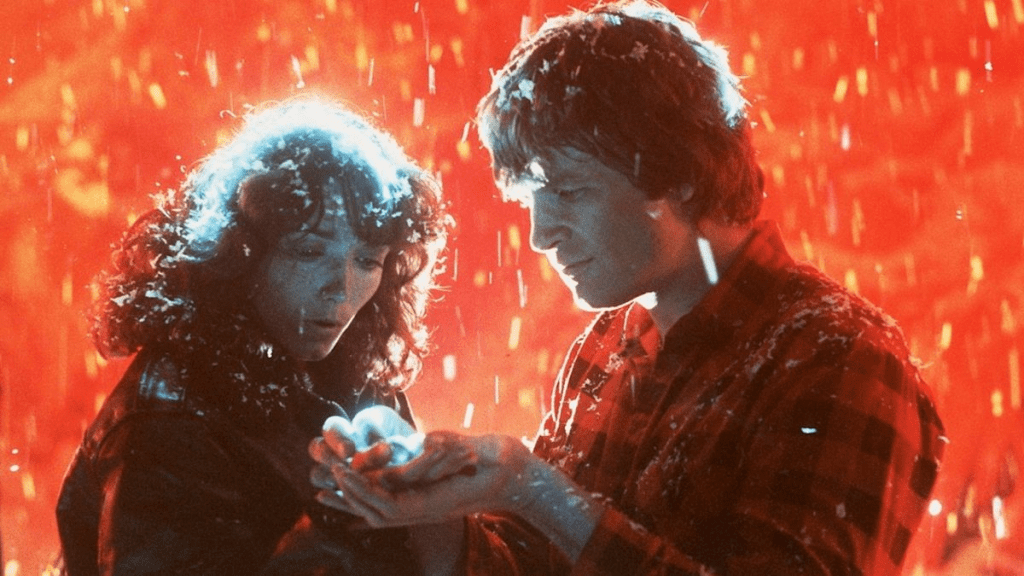
Starman, 1984.
 Junction 36
Leave a comment